


A truck sitting in a repair bay isn’t just a maintenance problem — it’s a revenue problem. Most fleet managers understand this at a surface level, but few have done the math on what a single breakdown actually costs when you account for everything: the lost revenue, the driver wages, the towing fees, the expedited parts, the rental unit, the missed delivery penalties, and the customer relationship damage that doesn’t show up on any invoice.
The number is almost always higher than expected. Industry data consistently puts unplanned commercial truck downtime in the range of $448 to $760 per truck per day — and that’s a conservative estimate for fleets that track these costs at all. For fleets that don’t, the true figure is often invisible until it starts showing up in thinning margins.
Understanding the full scope of downtime costs is the first step toward doing something about them.
Why the Repair Bill Is Only Part of the Story
When a Class 8 truck breaks down on the road, the repair itself might cost $1,200. But that number tells you almost nothing about the actual financial impact on your operation. The real damage accumulates in layers.
First, there’s the tow. Roadside recovery for a heavy-duty truck can run $400 to $800 depending on location and time of day. Then there’s the driver — still on the clock, still drawing wages, potentially eligible for breakdown pay under their contract, and generating zero revenue while they wait. If the load has a delivery commitment attached to it, late fees or chargebacks may apply. If a substitute vehicle is needed to recover the freight, add rental costs. And if the shop is backed up, add another day or two of all the above.
By the time the truck is back on the road, that $1,200 repair has easily become a $3,000 to $5,000 event — before you factor in any damage to the customer relationship or the driver’s experience of the situation.
The Hidden Costs Most Fleets Don’t Track
Beyond the obvious line items, there are downtime-related costs that routinely go untracked simply because they don’t generate a separate invoice:
- Administrative time: Someone on your team is making calls, arranging the tow, coordinating with the shop, updating the shipper, and rescheduling loads. That time has a dollar value that rarely gets captured.
- Driver retention impact: Repeated breakdowns frustrate drivers. In an industry where turnover can cost $8,000 to $15,000 per driver to replace, equipment reliability is a retention issue, not just a maintenance issue.
- Compliance exposure: If a breakdown leads to a missed HOS reset, an out-of-service order, or a late inspection, the downstream compliance costs can dwarf the repair itself.
- Fuel penalties: A truck running rough before it finally breaks down has likely been burning excess fuel for days or weeks. That waste is downtime-adjacent but never counted in downtime figures.
These costs are real, they’re recurring, and they’re largely preventable with the right maintenance posture.
Reactive vs. Preventive: The Math That Changes Everything
The core argument for preventive maintenance isn’t complicated — planned work is cheaper than emergency work, every time. Labor rates for scheduled shop visits run $85 to $110 per hour at most independent facilities. The same work performed as an emergency repair commands $125 to $175 per hour, plus expedited parts shipping, plus the towing bill, plus everything else described above.
Research from the American Transportation Research Institute (ATRI) and the Technology & Maintenance Council (TMC) consistently shows that fleets running structured preventive maintenance programs spend 25 to 35 percent less on total maintenance costs than fleets that operate reactively. The savings aren’t from spending less on maintenance — they’re from spending it at the right time, under controlled conditions, before a component fails in the field.
For fleet managers looking to build or refine a preventive maintenance program, a solid starting point is reviewing proven commercial truck maintenance strategies for fleet managers that cover interval planning, cost tracking, and PM compliance benchmarks.
Where Technology Is Changing the Equation
Modern telematics and predictive diagnostics have shifted the maintenance conversation from scheduled intervals to condition-based intervention. Instead of changing the oil every 25,000 miles regardless of actual oil condition, connected trucks can report real-time data on oil pressure, coolant temperature, DPF soot load, battery voltage, and dozens of other parameters that signal a component approaching failure.
The practical impact is significant. Predictive maintenance systems reduce unexpected failures by as much as 70 percent in documented fleet deployments. That doesn’t mean zero breakdowns — it means that most failures are caught at the shop door rather than on the shoulder of the highway.
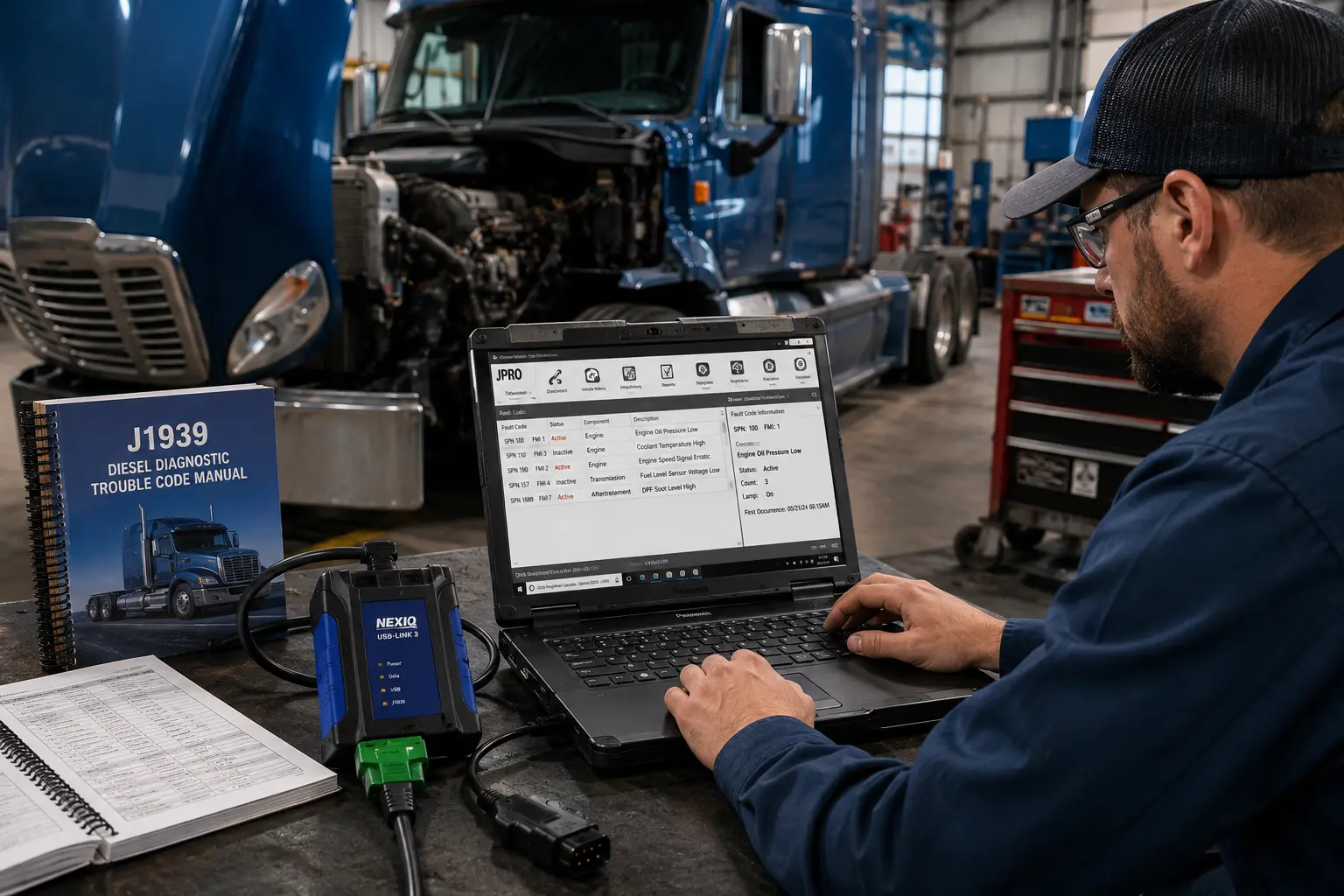
For smaller fleets and owner-operators who can’t justify enterprise telematics subscriptions, even basic fault code monitoring through a J1939-capable scan tool provides early warning that something is developing before it becomes a roadside emergency.
Calculating Your Fleet’s Actual Downtime Cost
Generic industry benchmarks are useful context, but they don’t tell you what downtime is actually costing your specific operation. A refrigerated LTL carrier has very different downtime economics than a flatbed hauler or a vocational dump truck fleet. Route density, load value, driver compensation structure, and customer SLA requirements all affect the math significantly.
The right approach is to build a downtime cost model using your own operating data: your average revenue per truck per day, your driver cost structure, your towing and rental history, and your repair invoice records. Once you have a realistic per-event cost figure, the ROI case for preventive maintenance and diagnostic tooling becomes straightforward arithmetic.
To get a fast baseline, the diesel fleet downtime cost calculator at Heavy Duty Journal walks through the key cost variables and generates a per-event and annual cost estimate you can use as a benchmark — free, no registration required.
Building a Downtime Reduction Strategy That Sticks
Reducing downtime isn’t a one-time project — it’s an operational discipline. The fleets that consistently outperform on uptime share a few common characteristics:
- They track downtime by vehicle, not just by incident. Pattern recognition at the asset level reveals chronic problem units that are dragging fleet-wide averages down.
- They hold shops accountable for repair quality, not just repair speed. A fast repair that fails in 30 days is more expensive than a thorough repair that takes an extra day.
- They treat drivers as an early warning system. Drivers who feel comfortable reporting minor issues before they escalate are your most cost-effective diagnostic tool.
- They review downtime data in regular operations meetings. What gets measured and discussed gets managed. Downtime that’s only reviewed after it happens doesn’t drive behavioral change.
The commercial transportation industry operates on margins that leave little room for avoidable losses. Fleet managers who treat downtime as a strategic cost driver — not just a maintenance line item — consistently find measurable savings within the first operating year of a structured improvement effort.
The trucks that stay on the road are the ones that pay for the ones that don’t.
